
Louisiana DPS&C Release Paths
Louisiana Department of Public Safety & Corrections legal custody covers state sentences in state institutions and can also cover people physically held in local jails. For a Bossier Parish person, the last building might be a state prison, Bossier Maximum, Bossier Medium, or the Transitional Work Program. The legal custodian, not the street address alone, determines which release and discharge records matter.
A person may leave confinement through full-term discharge, discretionary parole, good-time release, a court change, or another lawful path. Physical release can be followed by community supervision. Movement from a Bossier facility to a state institution is a transfer, not release. The record must preserve that difference.
Search Louisiana State Releases
DPS&C directs the public to LAVINE on VINELink. Louisiana states that the service can be searched by location, name, and an available ID or case field, and that it includes imprisoned people and people under probation or parole supervision. Data is described as updating every 24 hours. That interval is periodic, not instant.
- Select Louisiana and open the person or offender search.
- Enter the fewest reliable identity fields, preferably a DPS&C number when known.
- Compare name, age or birth information, ID, and last location before opening a record.
- Read the displayed status, custody event, location, and date labels literally.
- Use the telephone locator and a DPS&C record request if no public result settles the release.
A released or out-of-custody label differs from community supervision. No result is not a discharge certificate. Search spelling variants and call the official locator before drawing a conclusion. The Bossier Parish released-inmate search covers the local Sheriff and court records that can corroborate the state event.
Louisiana DPS&C Contact Route
The automated DPS&C locator is the documented phone route for facility and projected-date information. The official DPS&C inmate-information page explains that route. It accepts the DPS&C number or a name and date of birth. The system can provide a facility assignment, facility address and phone, a projected release date when applicable, and an assigned Probation and Parole district after assignment.
Louisiana DPS&C Locator
Automated offender locator: 225-383-4580
LAVINE status and notifications: 866-LAVNS-4-U
Web search: Louisiana VINELink / LAVINE
The phone locator is especially important when a projected date does not appear online. DPS&C says no date can mean the time calculation has not been completed, often because official sentencing paperwork has not yet been received or processed. Call again later rather than estimating from the sentence.
Louisiana Release Search Fields
The online and telephone routes return different details. Capture the label actually shown or spoken. Status terms such as incarcerated, released, out of custody, transfer, parole, probation, and community supervision should not be combined into one generic released category.
| Field or output | How to use it |
|---|---|
| Name and DPS&C number | Match the correct state record |
| Location or facility assignment | Identify the current physical custodian |
| Status wording | Distinguish confinement, transfer, release, and supervision |
| Projected release date | Treat as a current estimate when applicable |
| Assigned P&P district | Identify the post-release supervision office |
| Discharge date | Confirm the public state-sentence completion fact |
For Bossier Parish supervision, the Shreveport P&P District covers Bossier and Caddo. Office assignment can remain relevant after physical release, while the former prison or local jail is no longer the best contact.
DPS&C Lookup Screen
The official Louisiana LAVINE search is the public offender-search route identified by DPS&C.
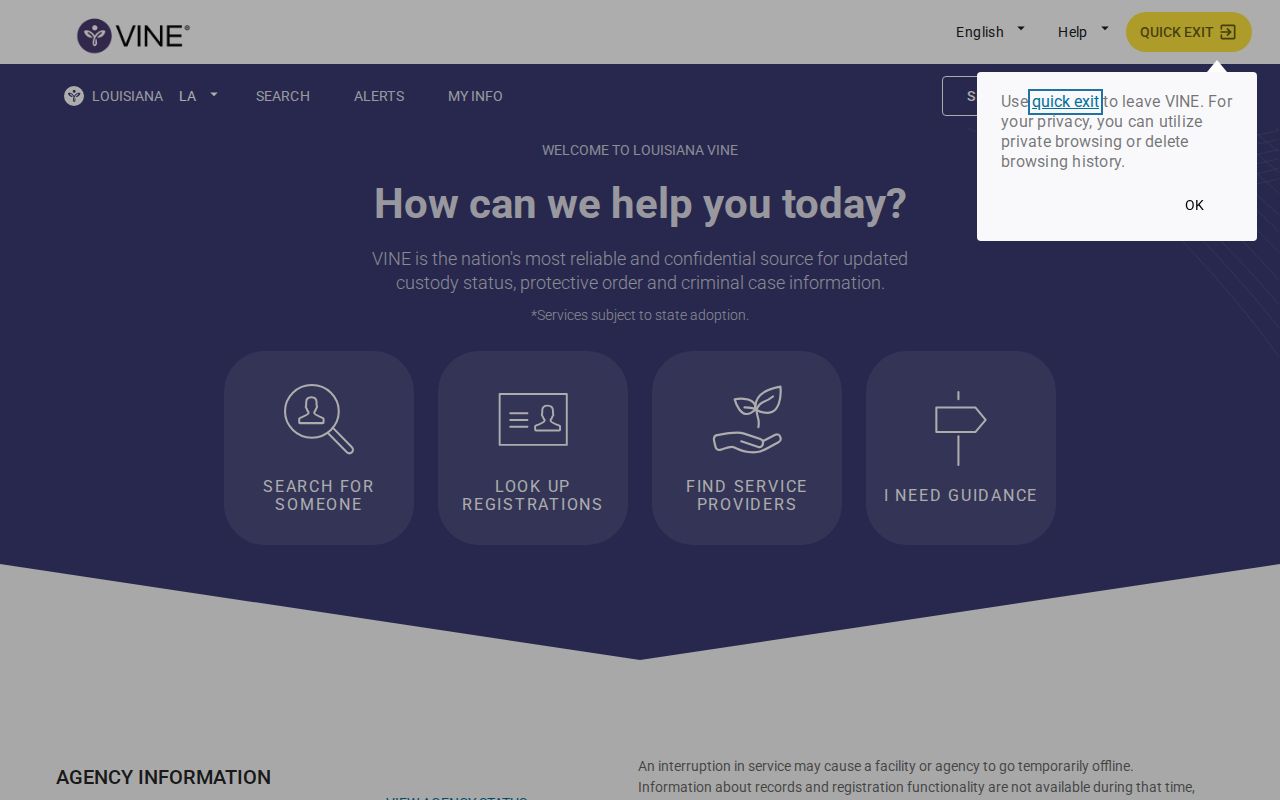
The screen is a starting point for a matched status. The original DPS&C record or phone locator is still needed when the result is absent, ambiguous, or limited.
Projected Louisiana Release Dates
A projected release date is a sentence computation, not an actual release record. It can depend on the sentence packet, jail credit, offense date, offense classification, statutory eligibility, and credits earned or lost. A court amendment, detainer, new sentence, revocation, recalculation, or administrative correction can change it.
For eligible felonies committed on or after August 1, 2024, Louisiana R.S. 15:571.3.1 permits ordinary good-time reduction up to fifteen percent of the imposed sentence, with exclusions and limits in the statute. The result often described as serving 85 percent is not a promise for every person. Older offense-date cohorts remain under different R.S. 15:571.3 rates and restrictions. Never apply one cohort's formula to another.
Note: Eligibility for credit or parole does not prove that DPS&C granted release or completed processing.
Louisiana Discharge Record Access
When an older result is no longer available through LAVINE, request the public DPS&C discharge information. Louisiana R.S. 15:574.12 protects broad corrections and parole material but identifies public-release categories in subsection G. Those categories include the criminal-charge and incarceration disposition, offense, conviction date, sentence length, and discharge date.
A focused request should identify the DPS&C number, name, sentencing court, and case. Ask separately for the discharge date, time-computation sheet, master-prison record, release certificate, or supervision assignment. Some parts may be withheld for lawful confidentiality, security, victim, medical, juvenile, sealed, or investigative reasons. Ask for the segregable public portions rather than an all-or-nothing file.
- Projected release
- A changeable forecast based on the current sentence calculation.
- Good-time release
- Release through statutory diminution, with the status and supervision set by applicable law.
- Parole
- Conditional release authorized through the state's parole process.
- Full-term discharge
- Completion of the correctional term without a remaining status from that sentence.
Bossier State Placement Distinction
Louisiana's Bossier Parish location page lists Bossier Maximum Security Center, Bossier Medium Correctional Center, and Bossier Transitional Work Program as local jails. None should be relabeled a state prison merely because DPS&C-sentenced people can be held there. Physical placement and state legal custody must both be stated.
When a DPS&C prisoner leaves one of those local sites, confirm the local movement or release event and then the state status. A move among the three Plain Dealing operations can change a location record while confinement continues. Completion of the Transitional Work Program can lead to supervision or discharge, but a return to a secure center is also possible. LAVINE and the DPS&C locator show the broader custody line.
Louisiana Supervision After Release
Physical release does not always end correctional authority. R.S. 15:571.5 addresses supervision after certain DPS&C good-time releases, while newer offense-date rules can produce different post-release treatment under their own text. Probation generally arises from a court sentence. Discretionary parole arises through the Committee on Parole process. Each should be named accurately.
The Shreveport Probation and Parole District is Bossier's local assignment office. LAVINE or the phone locator can identify an assigned district. A community-supervision entry supports release from confinement but is not the same as sentence discharge. Committee eligibility, a hearing date, or even a grant can precede actual release processing. Use the later DPS&C custody event to confirm departure.
Note: A parole decision explains authority; LAVINE or the DPS&C release record establishes the custody change.
Louisiana Release Evidence Order
The best proof is an actual DPS&C release certificate or discharge record tied to the correct number and date, supported by the court record and LAVINE status. A local Bossier facility event can show when the person left that building. Those records together separate transfer, community release, supervision, and final discharge.
A projected date, parole eligibility date, hearing date, roster disappearance, or unconfirmed report is a lead only. State release records change over time, and vendor results may not persist. Save the official identifiers, not a broad personal file, and request the durable record when the public view no longer resolves the event.
For an older Bossier Parish state case, pair the DPS&C discharge category with the sentencing court and case number. Ask whether the person reached full-term discharge or entered parole, good-time, or another community status. The answer affects which office now holds the useful record. A former local facility can confirm its physical event, but it cannot replace the statewide master record for the sentence.
When two sources use different dates, identify the label attached to each. A court order date, facility departure time, supervision start, and discharge date can all be valid while answering separate questions.